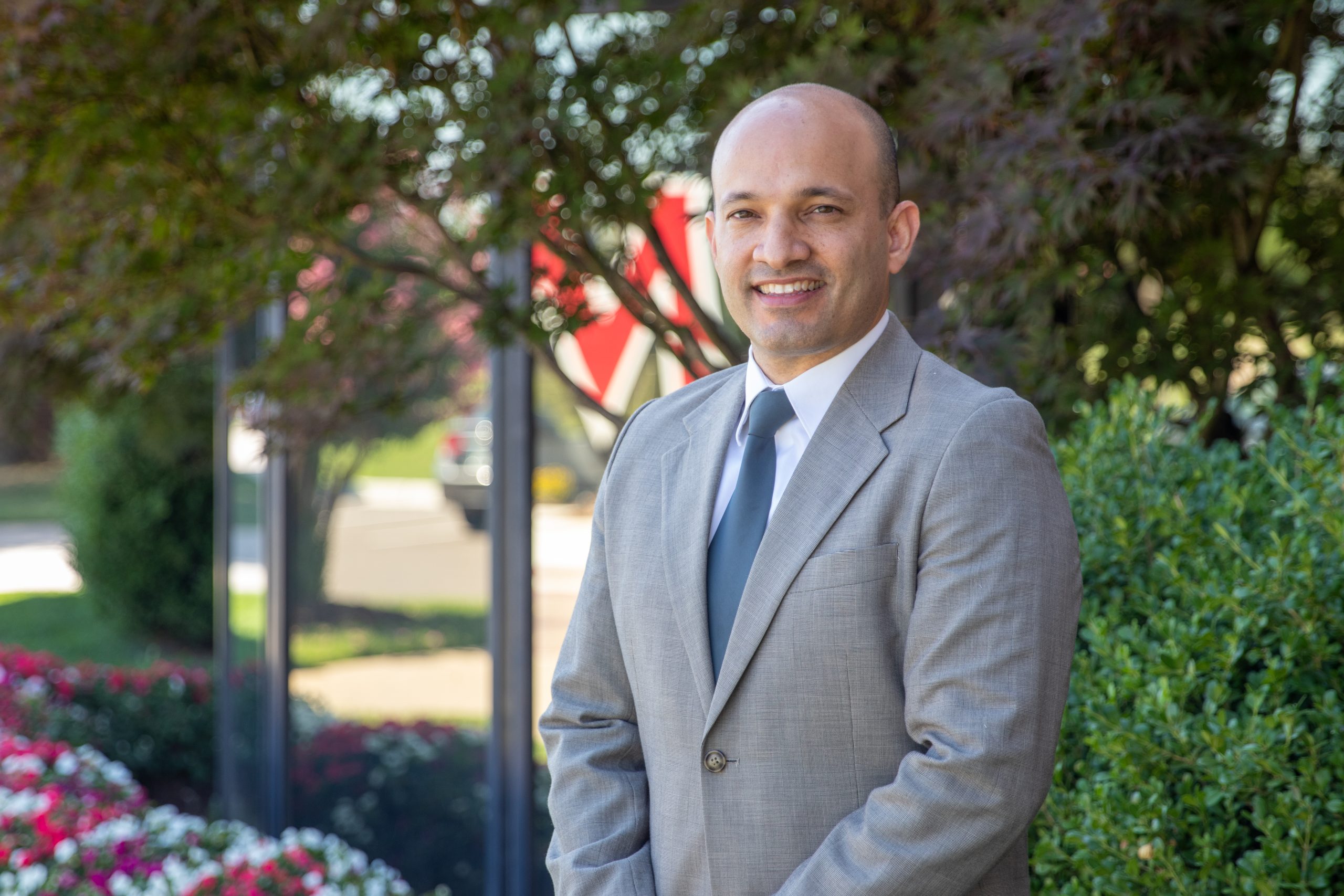
In 1995, Jesus Sampedro enrolled in a bachelor’s in business administration program in his native country of Venezuela. However, his business career was already underway by then. He had been helping his family run their industrial development firm from an early age. And, at age 15, he had launched his own retail clothing business.
“I grew up with people who were very intentional in helping me — handing me books and inviting me to places where there were going to be a lot of growth opportunities,” Sampedro says.
In addition to encouraging his business ambitions, Sampedro’s family also raised him to be a faithful follower of Jesus Christ. When he was two years old, his parents took him on a two-year-long mission trip abroad.
“For me, reading the Bible and knowing more about Jesus is the center of it all,” Sampedro says. “If we talk about leadership, … it’s hard to debate that Jesus is the most influential leader of all time.”
Given this background, it’s not difficult to imagine why Mid-America Christian University hired Sampedro to teach in and serve as program director of the Master of Arts (MA) in Leadership program. But this was only the beginning for Sampedro of a lifetime spent preparing to develop leaders.
Answering the Call to Leadership Development
Sampedro began his bachelor’s studies intending to become a business leader, but he soon realized he wanted to help other leaders on their journeys as well. He remembers exactly when that became his calling.
“It was February 23rd, 1999. I can remember because it was my birthday,” Sampedro says. “My father handed me a ticket to go to a leadership training initiative that was taking place in town.”
Although Sampedro had planned to celebrate his birthday with friends and family at the beach, his father ultimately convinced him to attend the seminar. Sampedro is glad he did.
“What I saw that day really blew my mind,” Sampedro says. “Everyone at the seminar was really interested. They were paying to be there. They wanted to grow and do better in their leadership, their businesses, their personal lives, and their families. I thought, ‘Hey, this is my thing. I hope I can find a space in this world where I can help other people grow.’”
Achieving His Dream and Taking a Risk
After earning his bachelor’s degree, Sampedro worked in banking, gaining a firsthand understanding of leadership and leadership development in the real world. It was a valuable experience, but in 2003, his ambitions pulled him away from the industry and to the United States, where he earned his Master of Business Administration (MBA) with an emphasis in marketing. He also became a certified leadership coach.
“After I finished my master’s, I went back to Venezuela and began working for a company in the training and consulting space,” Sampedro says.
Sampedro was finally working in his dream industry, but his drive to run his own business had never gone away. In 2005, at age 27, he gathered three partners and a team of consultants and launched his own consulting firm, LEADERSHIFT Global Leadership Consulting.
“That was a really scary moment,” Sampedro says. “I thought, ‘Am I really going to get any clients? … Maybe I’m a little crazy.’”
In the beginning, potential clients, especially large corporations, sometimes balked when they learned of Sampedro’s age. Believing in himself and his team’s expertise, he offered full refunds if clients walked away unsatisfied. No one felt the need to take him up on that offer.
Building Trust-Centered Business Cultures
As of 2026, Leadershift is celebrating 21 years in business. During that time, Sampedro has served clients in more than 30 countries and seen many of them struggle with one core issue.
“One of the biggest challenges is to establish an ecosystem of trust,” Sampedro says. “Creating a trustworthy organization requires trust within the ranks, and that’s not an easy thing to accomplish.”
According to Sampedro, building organizational trust is difficult because trust itself can be difficult to define. He helps clients overcome this obstacle by breaking down trust into 12 components, each with its own recommendations for how to achieve it.
“Each component builds upon the other one to create an ecosystem of interactions around the way people build things that leverage trust,” Sampedro explains.
Transparency is one of the most important components, but that alone is rarely enough to build trust with others.
“You normally want to go to people who speak the truth, right?” Sampedro says. “But at the same time, people also want to work with others who have delivered results in the past, are committed to delivering results in the present, and have the intention to deliver in the future. That’s related to the component of capacity.”
Coming to MACU: A Perfect Match
As Sampedro carved out his place in the consulting world, he occasionally taught leadership classes at local universities. He also remained dedicated to his own development. In 2008, he earned his Doctor of Strategic Leadership and was invited to teach at MACU as an adjunct professor.
For the next 10 years, Sampedro taught classes on decision-making in MACU’s online Master of Arts in Leadership in Spanish program from his home in Venezuela. He continued coaching leaders while writing books and conducting research.
In 2018, MACU brought him to campus to lead a seminar for students and business leaders in Oklahoma City. After the seminar, the school’s leadership asked him to consider staying on full time. Sampedro excitedly accepted.
“I always had a great appreciation for the school’s sense of growth and innovation, … and how they were intentionally integrating faith into leadership,” he says of his decision.
A Forward-Thinking Approach to Leadership Education
Today, Sampedro teaches online and on-campus classes in MACU’s MA in Leadership and MBA programs. In addition to the Organizational Behavior and Decision-Making and Data Analytics courses, he occasionally instructs on topics such as global team leadership and coaching.
“We teach not only at the skills level, but we also want to make students capable of being adaptive to the complexity of different environments,” Sampedro says of the MA in Leadership program. To accomplish that goal, the program focuses on topics such as change management and long-term strategic planning.
“The way we approach leadership is that leaders are solving problems that are not yet there,” Sampedro explains. “They’re trying to figure out what’s going to come up in five years, so they can start taking action today.”
Driving Growth in MACU’s Leadership Program
Sampedro applies the forward-thinking approach he teaches in class to his role as program director of the MA in Leadership program. Recently, he and his colleagues added two new degree emphasis areas in anticipation of evolving workforce needs: Organizational Leadership and Global Leadership.
“The Organizational Leadership option is focusing on the ethical dimension of leadership in the organizational world,” Sampedro says. “It also focuses on the strategic thinking and foresight capacities needed for the complexity we’re living in right now. … We’re envisioning it to become one of the strongest emphases in the very near future.”
The second new emphasis area, Global Leadership, was inspired by the program’s move to relaunch MACU’s leadership school as the Thomas School of Global Leadership as well as by the global nature of today’s economy.
“The school is now also expanding in terms of developing new partnerships with global entities,” Sampedro says. “We’re already beginning to offer trips to different parts of the world that are connected to classes. We’re very intentional in ensuring this concentration is not just a theoretical approach to global leadership, it’s hands-on.”
No matter how the MA in Leadership program evolves, Sampedro says it will remain centered on a biblically informed servant leadership approach.
“One of the things we highlight in all the classes is how leaders can treat people and pursue the best possible benefits for the great majority of people,” he says. “We try to bring things to a more conscious, ethical, and values-aligned framework.”
Become the Servant Leader Your Organization Needs Today
Modern leaders in every industry need to have the ability to foster a culture of innovation, trust, and collaboration. In Mid-America Christian University’s 100% online Master of Arts in Leadership program, working professionals can develop that capability on their own schedule, with expert instruction from Dr. Jesus Sampedro and his colleagues.
Over the course of 18 months, students learn to guide and inspire teams using a data-driven servant leadership framework they can apply in any industry. With seven emphasis areas to choose from — Business Management, Communication, Global Leadership, Higher Education Administration, Public Administration, Ministry Leadership, and Organizational Leadership — students can tailor this globally oriented program to fit their own goals.
“When we talk about global leadership, we’re not only talking about sending people to other countries,” Sampedro says. “We’re talking about equipping them with the capacities for them to lead anywhere. Anywhere they’re put in an organization or anywhere in the world.”
Learn more about MACU’s MA in Leadership program and its curriculum and emphasis areas.
Recommended Readings
Developing Global Leaders: A Conversation With Dr. LeAnn Brown
Making a Calling a Career: Graduate Shamra Hicks’ Master’s in Leadership Experience at MACU
From Psychology to Consulting to Education: Kelly Riesenmy, PhD, on Her Career and MACU’s MBA Program